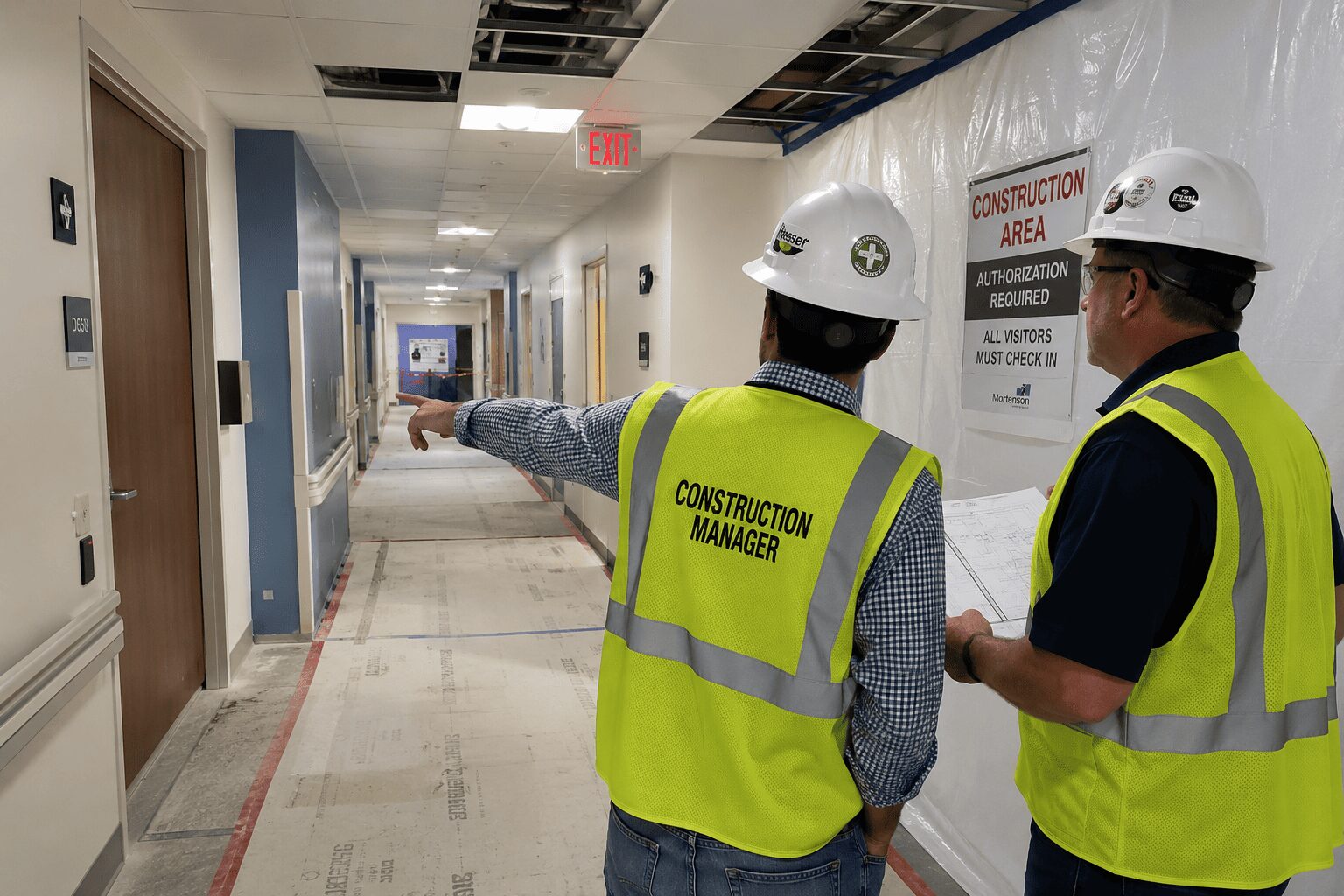
Healthcare construction management is different because the jobsite is not always separate from the owner’s real operation. In many healthcare projects, the building is still serving patients while construction is happening nearby.
That changes the work.
A hospital renovation is not just a schedule, a budget, and a set of drawings. It is a live environment with patients, staff, visitors, infection prevention teams, facilities leaders, utility systems, shutdown windows, noise concerns, dust control, and constant communication pressure.
That is why healthcare construction project management cannot be treated like normal commercial construction with medical equipment added later. The work needs leaders who understand how field decisions affect care delivery.
For contractors and owners, the hiring bar is higher because the margin for disruption is lower.
Healthcare Construction Management Has a Different Risk Profile
Every construction sector has risk.
Healthcare work carries a different kind of risk because the project can affect people who are already vulnerable. That does not mean every hospital project is chaotic. It means leadership has to be more disciplined.
A strong healthcare construction manager has to think beyond production. The job still needs schedule control, subcontractor coordination, cost tracking, owner communication, and quality execution. But the leader also has to understand how phasing, containment, access, noise, vibration, infection control, and utility interruptions can affect the facility.
ASHE says ICRA 2.0 was created to promote interdisciplinary infection prevention in health care facilities during construction, renovation, and maintenance. That point matters. Healthcare construction is not only about building the work. It is about protecting the environment around the work.
This is where average leadership gets exposed.
A project manager who only sees the schedule may miss the operational risk. A superintendent who only sees the work zone may miss the patient-care impact. A contractor who treats a shutdown like a normal coordination item may create bigger problems for the owner.
That is why healthcare construction leadership has to balance field execution with facility sensitivity.
Live-Site Healthcare Construction Tests More Than Construction Skill
Live-site healthcare construction is one of the clearest tests of leadership fit.
The work may involve occupied corridors, temporary access routes, infection control barriers, negative air requirements, nighttime work, operating department adjacency, emergency power coordination, or shutdowns that need approval from multiple stakeholders.
None of that is theoretical.
The CDC recommends infection-control measures during internal construction, including barriers that prevent dust from entering patient-care areas. It also recommends sealing return air vents when rigid barriers are used for containment. Those recommendations make one thing clear: the construction plan and the patient-care environment cannot be separated.
That is why the wrong healthcare construction project manager can create risk even with a technically capable subcontractor team.
The leader has to know when to slow down and get the right people in the room. They have to know when a field decision needs infection prevention input. They have to understand that a small access change may matter to nursing, security, environmental services, facilities, and patient transport.
That kind of judgment does not always show up in a title.
It shows up in how someone talks through phasing, shutdown planning, stakeholder communication, lessons learned, and jobsite controls.
This is why healthcare construction hiring should not be based only on project size. A candidate who has managed a larger warehouse or office project may still struggle inside an active healthcare facility. The environment is different. The communication load is different. The consequence of poor coordination is different.
What Specialized Healthcare Construction Leaders Actually Do
Specialized does not mean complicated.
It means the leader knows what needs attention before it becomes a jobsite problem.
A strong healthcare construction manager or superintendent is usually disciplined in five areas:
- Phasing: They sequence work around active operations.
- Communication: They keep facilities, users, subcontractors, and leadership aligned.
- Shutdown planning: They treat utility interruptions as operational events, not simple schedule items.
- Containment: They understand dust, air, access, and infection-control expectations.
- Closeout: They protect documentation, inspections, punch work, and turnover quality.
The Joint Commission says a hospital’s preconstruction risk assessment covers potential risks to patients, staff, visitors, or assets, including air quality, infection control, utility requirements, noise, vibration, and other hazards tied to the work.
That is a useful hiring screen by itself.
If a candidate cannot speak clearly about those areas, they may not be ready to lead a sensitive healthcare project.
That does not mean every hire needs 20 years of hospital work. But the leader must understand why healthcare facility construction management requires a different level of planning, coordination, and communication.
This is also where healthcare work connects to broader labor pressure. TBG has covered how roles contractors still cannot fill in 2026 are becoming harder to replace, especially when the role protects schedule, client trust, and execution quality.
Healthcare projects make that pressure sharper because one weak leadership fit can create problems far beyond the punch list.
A Practical Healthcare Construction Hiring Scenario
Picture a contractor awarded a phased renovation inside an active hospital.
The job is not massive on paper. The contract value is manageable. The drawings look clean. The owner has done similar work before.
But the project touches active patient areas, requires temporary pathways, includes off-hour utility coordination, and depends on multiple user groups staying informed.
A generic PM may look at that job and think the key issue is schedule control.
A true healthcare construction project manager sees a different picture.
They ask who signs off on infection-control measures. They ask how access changes are communicated. They ask what happens if a shutdown runs long. They ask which user groups are most sensitive to noise or vibration. They ask how daily work will be communicated to facilities and clinical teams.
That is not bureaucracy.
That is risk control.
FGI describes its codes and guidelines as being used for the planning, design, and construction of hospitals, outpatient facilities, and residential care and support facilities. In other words, healthcare construction sits inside a built environment where safety, operations, and construction all meet.
When a contractor puts the wrong leader on that type of project, the job may still get built. But it may take more owner intervention, more rework, more tension, more calls, and more risk than necessary.
That is the hidden cost of weak fit.
The Hiring Bar Should Match the Project Risk
Healthcare construction hiring should start with the environment, not just the job title.
A hiring manager should ask: What kind of facility is this? Is the work occupied? Are there shutdowns? Are there infection-control requirements? Is the owner experienced? Are user groups involved? Is the schedule aggressive? Does the role require heavy field leadership, owner communication, or both?
Those questions change the profile.
Sometimes the right person is a healthcare construction project manager with deep renovation experience. Sometimes it is a superintendent who has lived through phased hospital work and knows how to protect the site. Sometimes it is a project executive who can keep the owner, design team, operations team, and field team aligned when the work gets tense.
This is where construction management of healthcare projects becomes commercial, not academic. The search has to be tied to the risk of the work. A phased hospital renovation, an occupied outpatient facility, or a healthcare buildout with tight shutdown windows needs more than someone available. It needs someone credible enough to lead without creating avoidable disruption.
That same leadership pressure is showing up in active markets. TBG has covered healthcare and hospitality construction leadership demand in Central Florida, where complex projects increase the need for leaders who can manage pressure without losing control.
The process matters too. A rushed search often creates weak screening, soft references, and surface-level interviews. That is why a disciplined commercial construction hiring strategy matters before the project is already exposed.
It also matters after the hire. Losing the wrong person at the wrong time can create real project disruption, which is why the cost of losing a project manager mid-project is more than a staffing problem. On healthcare work, it can become an operational risk problem.
Hospital construction project management also demands a sharper interview screen. The right questions should test judgment, not just project history.
If your team is planning healthcare work and needs help thinking through leadership fit or search strategy, The Birmingham Group supports contractors through construction recruiting for hiring managers.
For candidates with healthcare project experience, the same market pressure creates opportunity. You can review open construction jobs if you are considering your next move.
The clear takeaway is simple.
Healthcare construction management requires specialized leaders because live-site projects do not forgive weak coordination.
The best leaders understand the work, the facility, the people inside it, and the risk created when any one of those pieces is ignored.