Why Data Center Projects Are Outbidding Traditional Commercial Construction in 2026
The construction industry is entering a defining moment in 2026 as data center projects continue outbidding traditional commercial construction across major U.S. markets. Office buildings, retail spaces, and conventional commercial projects face lower activity and tight budgets, while data centers secure a growing share of construction spending through aggressive timelines, strong capital backing, and extensive infrastructure requirements. These developments reshape market dynamics as digital services and cloud computing expand nationwide. For broader industry context, see the Construction Industry Outlook 2026.
This shift reflects long-term redirection of capital toward digital infrastructure, artificial intelligence, and cloud services. Data center construction has moved from a specialized niche to the largest source of private-sector commercial construction demand. Individual data center projects now match or exceed the value of entire commercial development portfolios, signaling structural change in how infrastructure development is prioritized.
The rapid expansion of cloud computing, artificial intelligence, and digital services drives this movement. Data centers support the digital economy for government, business, healthcare, and consumers. Electricity demand from data centers could more than double by 2030, reaching about 945 TWh. This increase highlights the pressure on national power supply, cooling requirements, and grid capacity. ENR recently reported accelerating utility-scale upgrades tied to AI growth, reinforcing this shift (ENR).

The Financial Advantage: Project Valuations That Outpace Traditional Commercial Construction
Data center projects command higher bids because of the unmatched size and value of these developments. Current averages range from $7 million to $12 million per megawatt of capacity, while hyperscale campuses can exceed $20 billion in total investment. Many projects fall between $500 million and $2 billion, far beyond traditional commercial construction. Continuous construction activity and fast-track schedules require large labor forces, sometimes involving thousands of skilled trades workers. The pressure to bring capacity online fast increases contractor rates and overall project spending.
Traditional office and retail projects continue to face lower demand and cautious lenders. Corporate real estate budgets favor digital infrastructure, leaving limited capital for conventional commercial builds. This gives data center developers a strong advantage when competing for construction resources. For more industry updates, visit the TBG Media Hub.
Hyperscale expansion from companies such as Amazon, Microsoft, Google Cloud, Meta, xAI, and OpenAI drives this movement. These firms deploy hundreds of billions of dollars into infrastructure development. Private equity and institutional investors continue expanding their digital infrastructure allocations. ConstructionDive has also reported on this capital surge (ConstructionDive).
| Project Type | Average Project Value | Typical Timeline | Capital Availability |
|---|---|---|---|
| Hyperscale Data Center | $15–20 billion | 18–24 months | Extensive |
| Traditional Office Complex | $50–200 million | 24–36 months | Limited |
| Retail Development | $20–100 million | 18–30 months | Restricted |
| Industrial Warehouse | $25–75 million | 12–18 months | Moderate |
Data center projects carry more predictable financial stability than traditional commercial construction. Cloud providers operate with multi-year budgets, consistent demand, and dependable revenue streams from digital services. Payment reliability is strong, and the risk of cancellation remains low, reducing uncertainty for contractors and subcontractors.
Market Demand Dynamics: Growth in Digital Infrastructure vs. Decline in Traditional Commercial Segments
Global data center capacity needs continue rising fast, with projections indicating that overall capacity could triple by 2030. The United States remains the largest single market for new data center construction, with strong annual growth in the range of 20 to 25 percent. These levels far exceed anything seen in traditional commercial construction categories. Up to $7 trillion in global data center investment is projected by 2030, and a large portion of this spending could pass through U.S. construction markets. For context on contractor impact, review the TBG analysis on construction salary movement.
Traditional commercial construction continues to face tight lending requirements and cautious corporate planning. Many companies continue reducing office footprints while increasing spending on cloud computing, digital services, and artificial intelligence. This trend creates a direct transfer of construction spending from traditional commercial projects to data center facilities. Hyperscalers dominate new private-sector spending, and their announcements often rival or exceed the yearly construction budgets of entire commercial segments.
Current forecasts show that around 70 percent of projected data center demand through 2030 will come from hyperscale development. This creates stable long-term opportunities for contractors that specialize in digital infrastructure. Surge capacity in cloud services pushes developers to expand across multiple regions simultaneously. This differs from traditional commercial construction, which tends to remain local and cyclical. Cloud providers now build in primary and secondary markets to create redundancy, reduce latency, and increase availability across the digital economy.

Technical Complexity Creates High-Value Premiums for Contractors
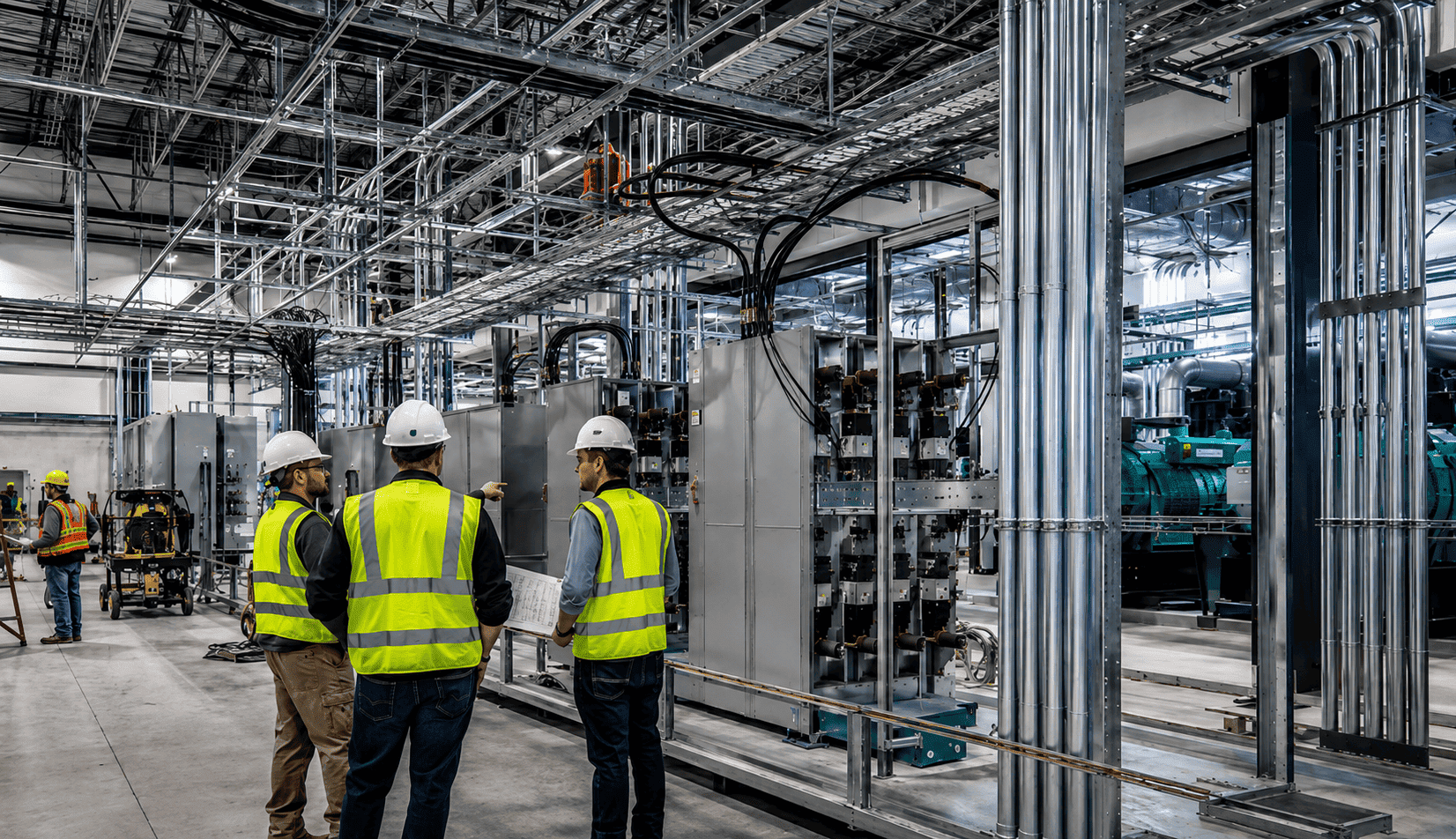
Data centers require cooling systems, high-density power distribution, cybersecurity layers, and digital tools that traditional commercial construction does not typically include. Compressed build schedules of 12 to 18 months add pressure on project timelines. These timelines require project managers with experience in complex MEP coordination, BIM models, and infrastructure development. Contractors often work within strict service-level requirements that demand precision to avoid costly delays and compliance issues.
Power supply needs for AI-driven data centers continue to rise. A single large facility can use as much electricity as a small city. This demand creates pressure on regional grid capacity and opens new opportunities for infrastructure development projects tied to transmission, distribution, and power generation. ENR recently highlighted an increase in utility-scale upgrades to support digital infrastructure (ENR).
Cooling requirements for these facilities remain a central challenge. Water consumption for large data centers can reach several million liters per day. This forces developers to consider water access, conservation strategies, and sustainable materials. These technical factors increase the scope and cost of construction and create natural separation between data center contractors and traditional commercial builders.
Supply chain constraints also impact project timelines. Lead times for vital equipment such as high-capacity transformers, power distribution gear, and advanced cooling systems can reach 12 to 14 months. These constraints require long-range planning and strong risk management systems to avoid project delays. Contractors with experience in supply chain challenges continue to see higher demand in the digital infrastructure sector.
Workforce Demands and Labor Costs
Data center construction requires specialized workers trained in advanced electrical systems, cooling technologies, and commissioning processes. Electricians, network infrastructure technicians, controls specialists, and commissioning teams receive higher compensation because demand outpaces labor availability nationwide. Data center contractors often offer premium pay to maintain project timelines. To learn how workforce shortages influence pay across skilled trades, review the TBG 2025–2026 Construction Salary Guide.
Project managers with data center experience continue to see high demand. Their work includes managing large-scale MEP coordination, evaluating power supply needs, reviewing BIM models, and collaborating with cloud providers to meet compliance standards. These skills differ from traditional commercial construction and create distinct labor markets.
Investment Support, Revenue Stability, and Financial Predictability
Cloud providers operate with stable revenue models and multi-year planning horizons. This creates dependable payment cycles for contractors. State and federal governments also support data center development through incentive programs, tax structures, and workforce training grants. These programs attract hyperscalers and reduce financial risk for contractors.
Traditional commercial construction remains exposed to higher borrowing costs, slower leasing activity, and fluctuating demand. Projects may face cancellation risks and delayed payment schedules. Mortgage rate increases have also reduced new commercial activity. In contrast, data center operators often secure long-term capacity agreements that stabilize revenue for decades. These agreements lower overall risk for construction partners and support long-term financial planning. The AGC continues to highlight how stable sectors deliver more consistent work for contractors.
Some data center operators also integrate on-site power generation to improve reliability, reduce stress on local grids, and support uninterrupted operations. Institutional investors see data centers as stable assets with long-term value. Funds, trusts, and global institutions continue expanding their infrastructure allocations, increasing available construction financing.

Risk Profile and Return Potential
Data center construction offers consistent margins because many design elements repeat across multiple sites. Standardization allows contractors to streamline procurement, replicate successful workflows, and reduce execution risks. Traditional commercial projects depend heavily on local economic cycles, leasing demand, and lender approvals. This increases uncertainty and limits pricing flexibility.
Institutional and public-sector projects provide stable work but cannot match the scale of hyperscale development. Public procurement requirements often restrict contractor margins and extend project timelines. In contrast, experienced data center contractors rely on proven processes for power supply planning, cooling systems, redundancy, BIM coordination, and commissioning. These systems reduce schedule uncertainty and improve project outcomes. Arbitration remains common for dispute resolution due to confidentiality and technical specificity.
Geographic Expansion, Market Saturation, and Regional Growth
Northern Virginia remains the leading data center market in the world, supported by strong grid capacity, favorable regulations, and established infrastructure. The United States is projected to support a large share of global data center power demand by 2028, which reinforces the importance of continued infrastructure development across multiple regions. ConstructionDive has reported increasing utility-scale investment tied to digital infrastructure growth (ConstructionDive).
As primary markets such as Northern Virginia reach capacity limits, cloud providers continue shifting toward secondary and emerging regions including Ohio, Arizona, Texas, Iowa, and parts of the Southeast. Ohio has expanded its data center capacity multiple times over the last decade because of large-scale investments from major cloud providers. These regions gain strong economic benefits as data center activity overtakes traditional commercial construction. This expansion trend can be seen in the TBG coverage of regional workforce demand at the Construction Blog.
Traditional commercial development continues to struggle with local zoning restrictions, tighter access to capital, and inconsistent leasing demand. Data center developers benefit from public-private partnerships, incentive programs, and tax structures designed to attract infrastructure development. These programs reduce risks, shorten approval timelines, and increase overall project viability.
Grid capacity constraints create new opportunities for infrastructure development. Utility companies are investing billions into transmission and distribution improvements to support data center growth. This infrastructure expansion generates additional construction work beyond the data center buildings themselves. The Bureau of Labor Statistics continues to track how infrastructure investment influences employment in skilled trades across the country.

2026 Construction Outlook: A Dividing Line Between Digital and Traditional Construction
Construction spending projections for 2026 show overall growth in low single digits, but this masks the widening gap between digital infrastructure and traditional commercial segments. AI adoption, cloud expansion, and growing demand for digital services have created a strong cycle for data center construction. This shift mirrors trends seen in recent TBG research on emerging roles in the modern workforce, available through the TBG Media Hub.
Office, retail, and hospitality projects continue experiencing slower activity as companies prioritize digital services over physical expansion. Institutional construction provides consistent work in sectors such as healthcare and education but does not match the size or margin potential of hyperscale development. Public procurement requirements limit pricing flexibility and extend project timelines.
Data center development remains one of the strongest and most durable segments in commercial construction. These facilities support high-paying jobs in specialized trades, engineering, and long-term operations. Regions with active data center growth experience broader economic gains, increased tax revenue, and new opportunities for workforce development programs.
Policy changes related to immigration and workforce training will likely focus on meeting the specialized labor needs of data center construction. Local governments continue competing for data center investments, while traditional commercial development faces increasingly complex approval processes and project delays.
The 2026 construction landscape represents a clear shift in priority from traditional commercial space to digital infrastructure. Contractors who build strong capabilities in data center construction will benefit from consistent demand, higher rates, and strong long-term growth potential. This aligns with the broader talent movement seen across the industry, as highlighted in TBG’s insights on construction executive recruiting.
Frequently Asked Questions
Why are data center projects outbidding traditional commercial construction?
Data center projects offer larger budgets, faster timelines, strong investor support, and long-term demand tied to cloud computing and artificial intelligence. These factors allow developers to pay premium rates that traditional commercial projects cannot match.
Which regions in the United States benefit most from data center construction?
Northern Virginia, Ohio, Texas, Arizona, and Iowa remain top locations because of grid capacity, land availability, and supportive regulatory environments. New markets continue emerging as demand expands.
How do workforce shortages affect data center construction?
Skilled trades such as electricians, commissioning technicians, and specialized MEP teams receive higher compensation because data center work requires advanced technical skills. Contractors often offer premium pay to meet scheduling demands.
What challenges do contractors face in data center construction?
Supply chain delays, cooling requirements, power supply planning, grid constraints, and project timelines are the most common hurdles. These challenges require advanced planning and specialized technical expertise.
Is data center construction expected to grow beyond 2026?
Yes. Forecasts show continued expansion driven by artificial intelligence, cloud services, and increased reliance on digital tools. Long-term demand for capacity continues rising across most regions.
Ready to Build a High-Performing Construction Leadership Team?
Data center construction requires project managers, superintendents, estimators, and specialized trades leadership with advanced technical capability. If you need proven talent for complex commercial or digital infrastructure projects, TBG can help.
Submit Your Resume or explore more insights at our Construction Blog.