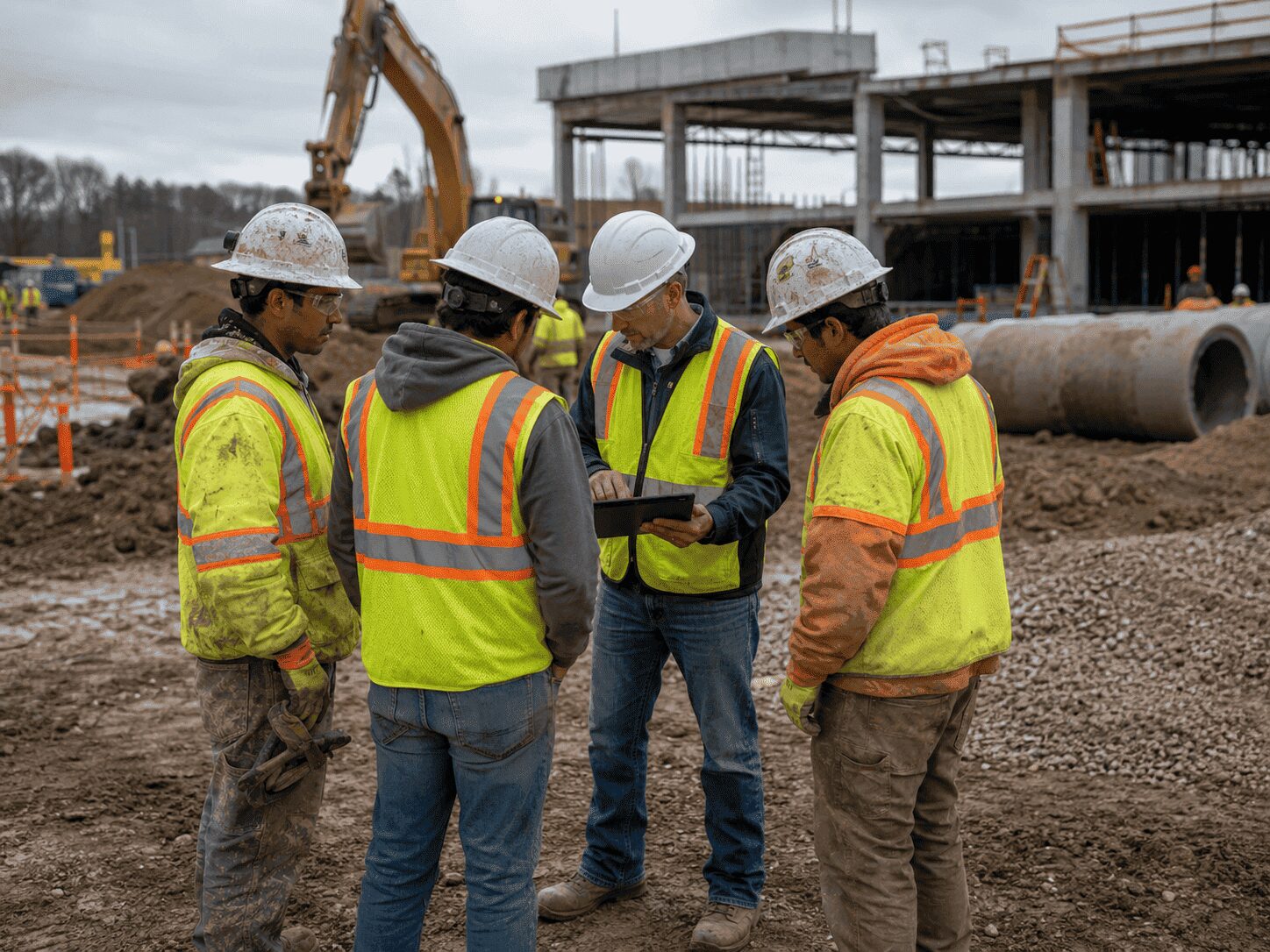

Inside Construction Workforce Development: Training, Leadership, and Retention
If you want to understand the labor market, ignore the noise and look at wages.
ConstructConnect reported that by January 2026, average hourly wages in construction climbed to $40.55 per hour, up 3.8% year over year, with average weekly pay at $1,590. That is roughly 25% more per week than the average private nonfarm worker. This is not a “nice to have” statistic. It is the market telling us something simple: competent tradespeople and field leaders are scarce.
Many firms compare these shifts against current benchmarks like the construction salary guide to understand how leadership compensation is moving.
Now look at the top end. In a Michigan data center discussion, Walbridge chairman John Rakolta Jr. said an electrician working at a data center could earn $150,000 a year. And in oil and gas pipeline work, there are welding roles where high-end, traveling welders can land well into six figures and, in strong years, push past $200,000.
So why do contractors still struggle to staff crews, train the next wave of foremen, and build a leadership bench?
Because pay is not the only bottleneck.
The bottleneck is training capacity, development systems, and early exposure. In other words, the “how” of building talent.
This is a practical playbook for building the construction workforce from the ground up, from early awareness to jobsite competency to a real foreman and superintendent pipeline. No slogans. No fluff. Just what works.
The Core Problem: Early Exposure Has Declined
When I was in school, shop class was not an optional elective that only a few students discovered. It was part of the system. You worked with real tools. You learned measurement, safety, and how materials behave. Some students were instantly pulled toward building. Others learned quickly that hands-on work was not for them. Either outcome was useful.
That exposure mattered because it answered a critical early question: Am I the kind of person who likes building things?
Over the years, many districts reduced that exposure. In some communities, a student can graduate without ever using tools in a structured environment. If we want more electricians, welders, operators, carpenters, pipefitters, and future superintendents by 2030, we cannot wait until people are 25 to introduce them to the work.
Demand Is Structural and Rising
Workforce development is urgent because demand is structural.
Retirements are real. Replacement demand is real. Project complexity is increasing across data centers, power and grid upgrades, advanced manufacturing, water and wastewater, and major institutional work. The result is predictable:
- Wages rise
- Competition rises
- Turnover rises
The firms that win are not the ones who complain the most. The firms that win are the ones who build talent intentionally and treat training as a production system. When internal leadership capacity is stretched, many organizations stabilize gaps through specialized construction recruiters.
A Workforce System, Not a Slogan
If you want a real workforce strategy, think in systems.
A workforce system has five parts:
- 1) Awareness (people see the path early)
- 2) Entry (people can start without friction)
- 3) Skill-building (structured progression, not chaos)
- 4) Leadership development (foreman, superintendent, PM bench)
- 5) Retention (people stay because the job works)
When one of these is weak, the pipeline breaks.
Awareness: Rebuild Early Exposure
The first job of workforce development is not training. It is exposure.
Students and career changers need to see the work, touch the work, and meet people who are proud of the work. That happens through:
- Middle school and early high school rotations that show multiple trades
- Jobsite tours that show modern construction, not stereotypes
- Craftspeople and field leaders speaking in classrooms, not just executives
- Parent nights that talk about earnings and career paths with facts, not opinion
Lead with wage reality. The market has already validated the trades as a viable, high-upside path. Many firms reinforce that visibility by aligning entry opportunities with active construction jobs demand.
If you want a pipeline, you have to make the path visible.
A Real Example Contractors Can Copy: Sachse Construction Academy
Sachse Construction has built a model that deserves attention. Through the Sachse Construction Academy, the company hosts Detroit high school students for a one-day, hands-on skilled trades experience on an active jobsite. Students begin with a real safety briefing, rotate through trade stations led by working professionals, and gain direct exposure to apprenticeship-style career paths.
The premise is simple but powerful: students cannot choose a path they have never seen. Early exposure turns abstract career ideas into something tangible. When students step onto a real jobsite, handle real tools, and interact with working craft professionals, the trades become real.
The model is replicable. It does not require a new building or a multi-year program. It requires coordination with a local school, a structured agenda, committed mentors, and leadership support. If more contractors ran structured, jobsite-based “try the trades” days, the pipeline would look materially different within a few years.
Entry: Make It Simple to Start
Most firms say they want apprentices. Then they make entry confusing, slow, or inconsistent. That is a self-inflicted problem.
A better entry model has two pieces: a clean on-ramp and a paid proving ground.
Pre-apprenticeship bootcamp (2 to 6 weeks) Teach the basics that reduce washout:
- Safety fundamentals and jobsite expectations
- Tool identification and tool care
- Measurement, layout, and prints basics
- Reliability standards: on time, every day, no excuses
- Communication: who to ask, how to ask, how to report problems
Paid trial period (30 to 60 days)
Pair each new entrant with a mentor and measure the right things:
- Attendance and punctuality
- Coachability
- Learning speed
- Work ethic
- Basic task execution quality
The workforce is not only 18-year-olds. Veterans, manufacturing workers, logistics workers, and adults stuck in low-wage work are a big part of the solution. Reduce friction at the front door and you increase starts. More starts means more finishers.
Skill-Building: Treat Apprenticeship as the Operating System
Apprenticeship works because it aligns incentives:
- Employers get productive labor that improves over time
- Apprentices get paid while learning
- Progression is measurable
The mistake most companies make is treating apprenticeship as a side program. It should be the operating system.
A practical apprenticeship system includes:
Written progression levels by trade Use simple levels that mean something:
- Level 1: safety, tools, basic tasks
- Level 2: independent production tasks
- Level 3: complex tasks plus coaching others
- Level 4: lead hand, coordination, planning
- Level 5: foreman readiness
Clear skill checklists
A checklist prevents “tribal knowledge only” training. It also prevents the apprentice from being stuck doing the same low-skill tasks for a year.
Mentor accountability
Mentors should get credit for advancement. If mentors are not measured, training becomes random.
Pay progression tied to demonstrated competency
Pay should move when skill moves, not just when time passes. Many contractors align competency progression with compensation benchmarks from the construction salary guide.
If you want to scale, you need a predictable way to create skill, not just buy it from competitors.
Jobsite Training: Build Repeatability Into Production
Many contractors confuse “put them on a crew” with “train them.” Training requires structure. The simplest system that works on real jobsites is weekly micro-training:
- 15 to 30 minutes
- One skill
- One standard
- One quick demo
- One quick field check later in the week
If you do this consistently, you create shared standards. Shared standards reduce rework. Reduced rework increases productivity. Increased productivity makes the job less stressful. Lower stress improves retention. It is all connected.
Also build “standard work” for common tasks. Film your best craftsperson doing the task correctly. Keep videos short. Use them in onboarding. This is not gimmicky. It is how you reduce variability.
Measure training by outcomes, not activity. Track:
- Rework rate
- Safety incidents
- Productivity per crew
- Schedule reliability
- Retention at 30, 90, and 180 days
If training does not improve these metrics, it is not training. It is busywork.
Leadership Development: Build Foremen and Superintendents on Purpose
The shortage is not only craft. It is leadership.
The fastest way to lose a good apprentice is to put them under a weak foreman. And the fastest way to blow a schedule is to put a strong crew under a leader who cannot plan.
Leadership development should be a formal track, not a hope.
Foreman development should include:
- Planning: daily targets, look-ahead, constraints
- Communication: clear direction, calm correction, no drama
- Productivity: what good looks like, how to measure it
- Coaching: teach, do not just bark
- Coordination: how to work with other trades
- Safety leadership: pre-task planning and accountability
Superintendent development should include:
- Sequencing and trade coordination
- Short-interval planning and schedule recovery
- Quality standards and punch prevention
- Owner and architect communication
- Manpower planning and resource forecasting
- Long-lead and procurement awareness (because late buyout shows up as field chaos)
Leadership is trained, not inherited. And leadership training is retention strategy. Long-term career path visibility often includes discussion of life after being superintendent as part of retention planning.
Retention: Design the Job People Want to Stay In
Retention is not pizza parties. Retention is job design.
People leave for predictable reasons:
- inconsistent hours
- weak field leadership
- unclear advancement
- constant chaos
- pay compression (new hires paid more than loyal people)
Strong firms do the basics well:
- Transparent career ladders
- Predictable progression standards
- Training that leads to pay increases
- Strong foremen and superintendents
- Respect for personal life, especially for travel roles
If travel is required, do not pretend it is a minor detail. It is a tax. Firms have to pay for it with rotation structure, compensation, and support.
Make Skilled Trades a First-Choice Career Again
This is the message the industry must say clearly:
Skilled trades are not a fallback. They are a high-upside career path.
The wage data supports it. The demand supports it. And the ceiling in certain segments is real. If we want parents, counselors, and students to take the trades seriously, we have to speak about them with the same clarity we use when we talk about engineering or accounting.
The marketing needs to be honest:
- This work is demanding
- It is not for everyone
- The earnings can be excellent
- The advancement can be real
- The pride is real
- The long-term stability is strong when you are skilled
When the message is honest, the right people lean in.
The Metric That Changes Everything: Time to Competency
Most firms track hiring. Few firms track development.
If you want to run workforce like a business system, track time to competency:
- How long does it take for a new hire to become productive at Level 2?
- How long does it take for an apprentice to reach Level 3?
- How long does it take for a high-potential craftsperson to become a capable foreman?
Then tie training resources to that metric. This is where training becomes an investment, not a cost.
Procurement Discipline Is a Workforce Strategy
This sounds unrelated until you see it in the field.
When procurement is late, leaders spend their time expediting, re-forecasting, explaining delays, and fighting change orders instead of leading crews. The job becomes chaotic. Chaotic jobs burn out strong superintendents and foremen. Weak systems also make it harder to train, because training requires a stable plan.
The best contractors protect their leaders by improving the basics:
- Early buyout on long-lead packages
- Clear scope and accountability at handoff from precon to operations
- Standardized reporting so the field is not reinventing the wheel every project
- Practical escalation planning so surprises are reduced
When the job runs cleaner, training improves. Retention improves. Leadership stays longer. That is why operational discipline is part of workforce development.
A Simple 90-Day Implementation Plan
If you want to move from talk to results, start with a 90-day reset.
Days 1 to 30
- Build your skills matrix by trade (Level 1 to Level 5)
- Launch weekly micro-training on jobsites
- Identify your best mentors and train them how to coach
- Design a simple pre-apprenticeship on-ramp
Days 31 to 60
- Partner with one local school or CTE program
- Host one jobsite-based exposure day (copy the Sachse model)
- Launch a paid summer tryout
- Begin structured foreman development
Days 61 to 90
- Tie pay progression to skill milestones
- Track retention at 30, 90, and 180 days
- Track time to competency
- Make training part of production, not an add-on
Bottom Line
Construction is paying for skill. The wage trend proves it. The opportunity is real and the upside is real.
But the workforce will not build itself.
The companies that win rebuild early exposure, simplify entry, run structured apprenticeship and jobsite training, develop field leadership intentionally, and treat retention as a design decision. Firms executing long-term workforce strategy often formalize support through hiring support aligned with leadership planning.
What is your biggest workforce bottleneck right now: awareness, entry, training capacity, or retention?
FAQs
What workforce training methods work best for construction companies?
The best results come from structured progression (skill levels + checklists), mentor accountability, and short weekly jobsite micro-training that ties to outcomes like rework, safety, and retention.
How can contractors build a foreman and superintendent pipeline?
Run a formal leadership track: foreman readiness standards, coaching training for mentors, planning and coordination skills, and clear promotion criteria tied to demonstrated competency, not tenure.
How long does it take to train a new construction hire to jobsite competency?
It depends on trade and job complexity, but the practical metric to track is “time to Level 2 productivity” (independent production tasks). Once you track it, you can shorten it with checklists, repeatable onboarding, and consistent micro-training.
Why do apprenticeships fail in some construction firms?
Most failures come from weak entry systems (confusing on-ramp), inconsistent mentorship, no written progression, and no pay progression tied to skills. Apprenticeship has to run like an operating system, not a side project.