
Hiring strong construction leaders is not the hard part.
Keeping them engaged long enough to hire them is.
Most companies focus heavily on sourcing. They talk to recruiters. They review resumes. They schedule interviews.
Then the process slows down.
A few days pass between conversations.
Feedback takes time.
Decisions drift.
Inside the company, it may not feel like a serious delay.
From the candidate’s perspective, it feels very different.
A-players do not sit in limbo.
Strong project managers, superintendents, estimators, and preconstruction leaders are rarely sitting on the market waiting for the perfect opportunity.
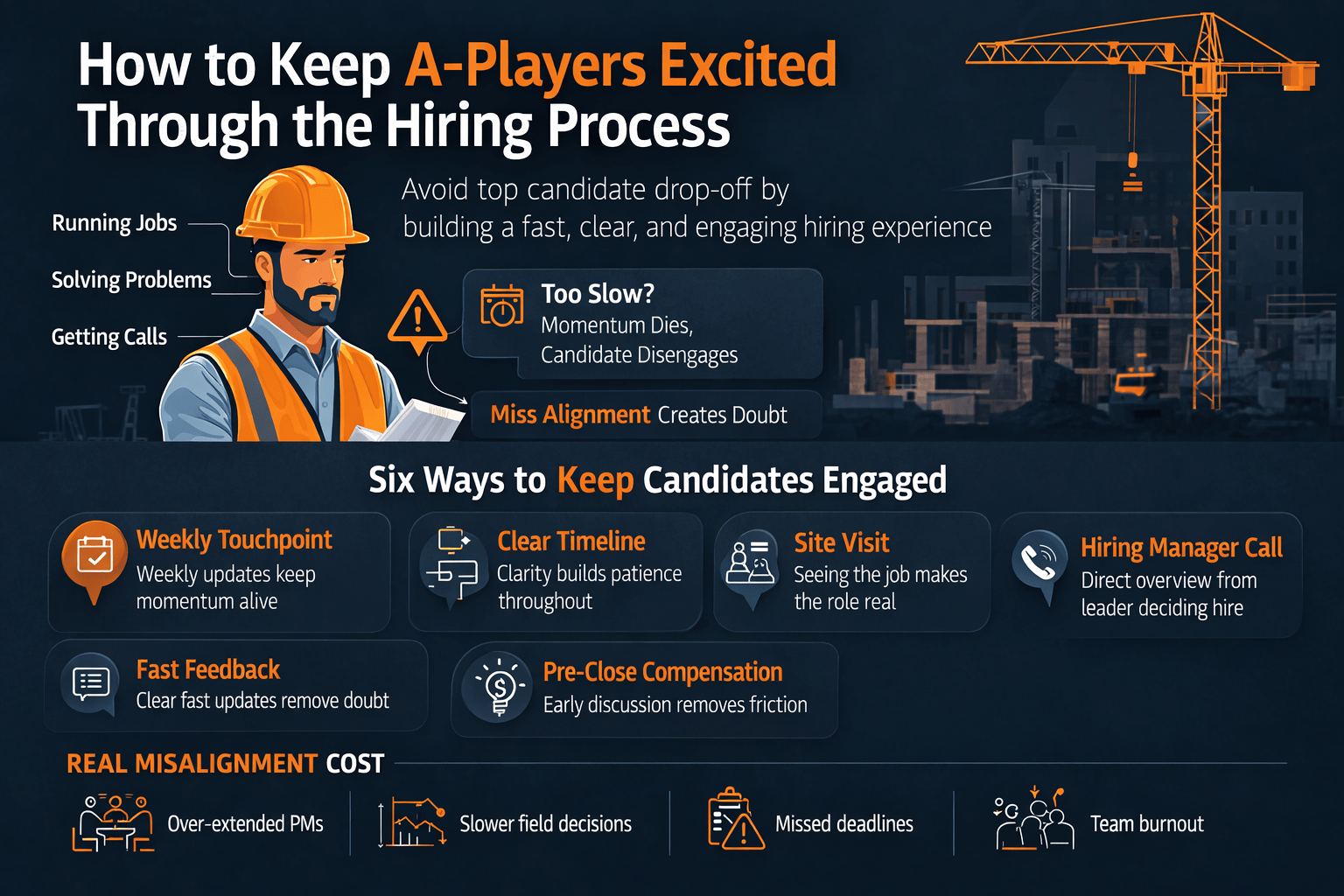
They are running jobs.
They are solving problems.
They are getting calls from other firms.
When they explore a new role, they are not only evaluating the job.
They are evaluating the company.
And the hiring process becomes the first signal.
If the process feels clear and organized, confidence grows.
If the process feels slow or uncertain, momentum fades.
That is where candidate drop-off begins.
Not because the opportunity is weak.
Because the process creates doubt.
Many firms solving this challenge partner with experienced construction executive recruiters who understand how to keep strong leadership candidates engaged through the hiring process.
Definitions
Before getting into the playbook, it helps to define a few terms clearly.
Pre-close
A pre-close is a conversation that tests whether the candidate would likely accept the role before a formal offer is made.
It surfaces concerns early.
It prevents surprises later.
Counteroffer
A counteroffer happens when a candidate’s current employer increases compensation or responsibility after learning the employee may leave.
This is common in construction leadership hiring.
Closing
Closing is the final stage of the hiring process.
The company presents the offer.
Questions are resolved.
The candidate decides.
Clear definitions lead to clearer hiring conversations.
And clarity keeps momentum alive.
Construction leadership hiring pressure has intensified across the industry as demand for experienced professionals rises across infrastructure and commercial sectors, according to the U.S. Bureau of Labor Statistics construction workforce outlook.
Why Top Candidates Drop Off
Strong candidates rarely disappear without warning.
The signals usually appear earlier.
Four issues show up again and again.
Slow Hiring Process
Speed does not mean rushing.
Two or three interviews over two or three weeks is reasonable.
That timeline works.
Silence does not.
Five days to schedule the next conversation.
A week waiting for feedback.
Another week before someone decides.
That is where momentum dies.
Strong candidates interpret hesitation as misalignment.
And misalignment pushes them toward other opportunities.
Vague Role Definition
Strong candidates want clarity.
They want to understand the real job.
Not just the title.
What projects they will lead.
What success looks like.
Who they report to.
Where the pressure points are.
When different interviewers describe the role differently, candidates notice immediately.
That creates doubt.
And doubt slows momentum.
Weak Communication
Communication gaps kill hiring momentum.
A candidate interviews.
The conversation goes well.
Then several days pass with no update.
Now the candidate begins asking internal questions.
Did the interview go poorly.
Is the company unsure about the role.
Is the job actually real.
Even if none of those concerns are true, uncertainty changes perception.
And perception drives decisions.
No Sense of Urgency
Construction runs on decisions.
Schedules move.
Problems appear.
Leaders respond.
Candidates expect hiring to operate the same way.
If the process feels passive or slow, they notice.
And they start wondering how the company actually runs projects.
That difference matters.
The Real Cost of Candidate Drop-Off
When a strong candidate disengages, the damage spreads.
The role stays open.
The team absorbs more pressure.
The same patterns appear across projects.
project managers covering too many jobs
superintendents stretched across multiple sites
slower decisions in the field
growing burnout
Hiring delays quickly become operational problems.
That is why momentum matters.
It protects the team already in place.
Six Ways to Keep A-Players Warm
Keeping strong candidates engaged is not complicated.
But it requires discipline.
Companies that close leadership hires consistently tend to follow the same habits.
Weekly Touchpoint
Silence creates doubt.
Even when there is no major update, communication matters.
A short check-in each week keeps the candidate connected to the process.
The message can be simple.
where the process stands
what conversations are happening internally
when the next step will occur
Small communication keeps momentum alive.
Clear Timeline
Candidates should understand the process early.
Explain the structure.
How many interviews.
Who they will meet.
When decisions will likely happen.
Clarity builds patience.
Uncertainty creates anxiety.
Site Visit
In construction, seeing the job matters.
A site visit changes the conversation.
The role becomes real.
Candidates see how the project operates.
They observe the team.
They watch how leadership communicates.
Those signals matter more than any job description.
Strong Hiring Manager Call
One conversation often determines whether a candidate stays engaged.
The hiring manager call.
Candidates want to hear directly from the leader they will work with.
The conversation should explain the real leadership challenge.
The expectations for the first year.
The kind of projects the leader will run.
When the hiring manager speaks clearly, the role becomes tangible.
Fast Feedback
Candidates do not expect instant decisions.
They expect clarity.
Within 24 hours of an interview they should know one of three things.
they are moving forward
the company needs time to decide
they are out
That level of clarity builds trust.
Delayed feedback creates doubt.
Pre-Close on Compensation
Compensation alignment should not wait until the final offer.
A pre-close conversation surfaces concerns early.
Typical questions include:
does the compensation range align with expectations
are there concerns about travel or schedule
if the role meets expectations would the candidate be comfortable moving forward
These conversations remove friction before the final step.
Many firms use real market data like the construction salary guide to confirm compensation alignment earlier in the hiring process.
The Hiring Process Is the Preview
Candidates assume the hiring process reflects the company.
If interviews are organized, they expect organized projects.
If communication is clear, they expect clear leadership.
If the process feels uncertain, they assume daily operations may feel the same way.
The hiring process is the preview.
Candidates notice this quickly.
Common Hiring Friction Points
Many hiring problems are internal.
Not market driven.
Typical friction points include:
too many interview rounds
unclear decision ownership
slow internal feedback
late compensation alignment
scheduling delays
Fix those issues and hiring momentum improves immediately.
A Simple Hiring Timeline That Works
A disciplined hiring process often looks like this.
Week 1
Initial conversation and first interview.
Goals
confirm role alignment
confirm compensation range
explain hiring timeline
Week 2
Second interview with leadership.
Goals
evaluate decision making
discuss leadership style
confirm expectations
Week 3
Final conversation and decision.
Goals
resolve remaining questions
complete pre-close
confirm offer timing
This is not rushed.
It is organized.
And organization builds confidence.
Many contractors monitor leadership demand trends using industry outlook research like the construction industry outlook to understand hiring pressure across projects.
Urgency Signals Leadership
Construction leaders solve problems quickly.
Candidates expect hiring to reflect that same discipline.
When the process moves decisively, confidence grows.
When it drifts, candidates quietly disengage.
That difference decides who wins the hire.
Keep the Process Human
Systems matter.
But the candidate experience matters too.
Small moments build connection.
A candid discussion about project challenges.
An introduction to the team.
Transparency about expectations.
Honest conversation about pressure points.
Those moments build trust.
Trust keeps strong candidates engaged.
The Bottom Line
Strong candidates rarely disappear without reason.
Most drop-off begins when hiring momentum disappears.
Slow timelines create doubt.
Unclear roles create confusion.
Weak communication creates distance.
Clear timelines.
Consistent updates.
Decisive leadership.
Those habits keep strong candidates engaged.
Companies that consistently win construction leaders do not lower standards.
They tighten the process.
That is how strong hires happen.
For companies actively hiring construction leaders, structured recruiting support can help maintain hiring momentum and candidate engagement through the process.
What is the biggest leadership pressure point you are seeing on jobs right now?
Losing Strong Candidates During the Hiring Process?
When hiring timelines drift, top project managers, superintendents, and estimators quietly move to the next opportunity. Benchmark compensation, tighten your hiring process, and secure proven construction leaders before competitors do.
Find Proven Construction Leaders
Construction professionals can also
submit a resume for confidential review.
FAQs
How long should a construction hiring process take?
A typical hiring process can range from one week to more than 30 days depending on the role, number of interviews, and internal decision speed. Many companies aim to complete leadership hiring within two to three weeks to avoid losing strong candidates to competing offers.
Why do strong candidates drop out of the hiring process?
Top candidates often disengage when the hiring process slows down, communication becomes unclear, or interview timelines stretch too long. Experienced construction leaders usually have multiple opportunities, so delays can signal uncertainty and push them toward faster-moving companies.
How can companies prevent candidate drop-off during hiring?
Clear timelines, weekly communication, fast interview feedback, and early discussions about compensation help keep candidates engaged. Companies that move decisively and communicate consistently are more likely to secure strong construction leaders.
What questions should candidates ask during a construction interview?
Candidates often ask about project pipeline, leadership expectations, team structure, and upcoming project milestones. These questions help them understand the company’s direction and whether the role aligns with their experience and career goals.


