Texas Construction Demand in 2026: Where the Largest Projects Collide
In August 2023, the Texas Transportation Commission adopted a record $142B 10-year Unified Transportation Program (UTP) covering statewide project programming through 2033. That funding cycle is already colliding with private-sector capital in energy, manufacturing, and digital infrastructure, which is why 2025–2026 becomes the “overlap years” for contractors trying to staff and sequence work.
For decision-makers in construction, development, and energy, the question is not “what is the biggest project.” The question is “where do the biggest programs stack on top of each other in 2026.” This article provides a 2026-focused view of the buildout reshaping the state: transportation corridors, ERCOT grid reinforcements, Gulf Coast industrial activity, semiconductor manufacturing, and data center expansion.
The Birmingham Group is writing from the perspective of a construction executive search firm that supports contractors and developers staffing these large programs. Workforce and hiring implications are addressed later. What follows is a verified, statewide view of how this investment is shaping construction demand heading into 2026.

Understanding the $142B TxDOT Unified Transportation Program
TxDOT’s Unified Transportation Program is a 10-year, statewide programming roadmap that is updated annually and approved by the Texas Transportation Commission. The 2024–2033 cycle totals about $142 billion, making it the largest UTP Texas has adopted to date.
Two things matter for 2026 planning:
- The UTP is not one project. It is thousands of packages across districts, metros, corridors, bridges, and preservation work.
- UTP timing overlaps private megaproject timing. A contractor that tries to staff heavy civil, industrial, and high-tech building work in the same geography in 2026 will feel the squeeze.
UTP documents and project lists are public and updated through TxDOT, which gives contractors a way to track letting schedules and corridor phasing without guessing.
Texas Transportation Projects 2026: I-35 and Urban Corridor Overhauls
The most visible UTP impact in 2026 is still urban freeway reconstruction. Interstate work is not “new lanes only.” The hard work is interchanges, frontage road rebuilds, drainage, bridge structures, and long-duration traffic control packages that demand deep field leadership benches.
For candidates tracking role movement in this cycle, keep an eye on the volume of 2026 postings tied to PM roles and travel-heavy superintendent assignments.
I-35 Capital Express in Austin
TxDOT’s I-35 Capital Express program is one of the clearest examples of how 2026 becomes a high-intensity overlap year. TxDOT and City materials show the corridor segment in Austin carries 200,000+ vehicles per day today and is projected to exceed 300,000 per day by 2045 under long-range assumptions.
The Capital Express Central project is widely cited at roughly $4.5B in estimated construction cost, while TxDOT program history references a fully funded construction figure of $4.9B tied to 2020 funding actions. These are not the same number, and this is exactly why contractors should cite sources instead of repeating one figure without context.
By 2026, the operational reality is simple: major Central Texas mobility packages will still be absorbing top-tier heavy civil leadership capacity, and they will compete with other sectors for the same people.
San Antonio, Waco, and Corridor Work
South and north of Austin, I-35 corridor work continues in multiple segments. Treat this as a corridor program, not one job. That mindset is what changes staffing strategy: a single superintendent assignment becomes a multi-year rotation plan.
Houston Highway Projects
Houston’s biggest headline work remains the I-45 North Houston Highway Improvement Project. TxDOT briefing materials have cited a current construction cost estimate of $7.9B (2021), while later commission materials and industry summaries have referenced higher totals (for example, $9.7B cited in a 2022 commission document). In other words, “about $7B” is not a safe number to print as fact.
What is safe to say: it is a multi-year reconstruction effort that will drive bridge, structures, and traffic-control staffing demand well through the mid-decade.
Dallas–Fort Worth Expansions
North Texas highway packages continue to expand and reconstruct major connectors that support DFW logistics, industrial parks, and growth corridors. In 2026, expect staffing pressure across heavy civil and vertical work in the same labor shed, which is why owners and contractors that plan early keep more control over cost and schedule.

Regional Corridors, Freight, and Port Connectivity
Beyond the headline interstates, UTP and related roadway work support freight movement between ports, refineries, industrial corridors, and inland distribution. This is where owners often underestimate scope. Port growth forces road packages, rail tie-ins, bridges, and heavy-haul access work that looks “secondary” until it becomes the constraint.
Key Freight Corridors Active in 2026
US 59 / future I-69: TxDOT continues upgrading segments of US 59 as part of the future I-69 system. This corridor matters in 2026 because it ties growth markets and freight routes into Houston and border trade flows without relying on one metro’s internal mobility alone.
I-10: Gulf Coast and East Texas improvements support heavy industrial trucking, port access, and petrochemical supply movement. Even “routine” widening or interchange work becomes complex when it must maintain flow for industrial traffic.
Outer loops and connectors: Houston-area loop and connector packages keep opening new industrial land and changing where distribution clusters form. That land use shift is one reason commercial and industrial hiring in Texas stays hot across multiple submarkets.
Port Connectivity Projects
Port Houston: Port Houston reports it ranks #1 in U.S. foreign waterborne tonnage (and publishes annual statistics for verification). That ranking is the practical reason interchange and connector projects stay on the critical path for owners that depend on import and export cycles.
Port of Corpus Christi: The Texas Comptroller’s port profile describes Corpus Christi as the nation’s largest energy export terminal. The Port itself also uses similar positioning language in its “About” materials. Source
Why this matters in 2026: freight and port packages are not isolated from LNG and industrial work. They stack in the same geography. That is why Gulf Coast field leadership moves fast, and why firms that treat port access as “someone else’s job” end up reacting to it late.
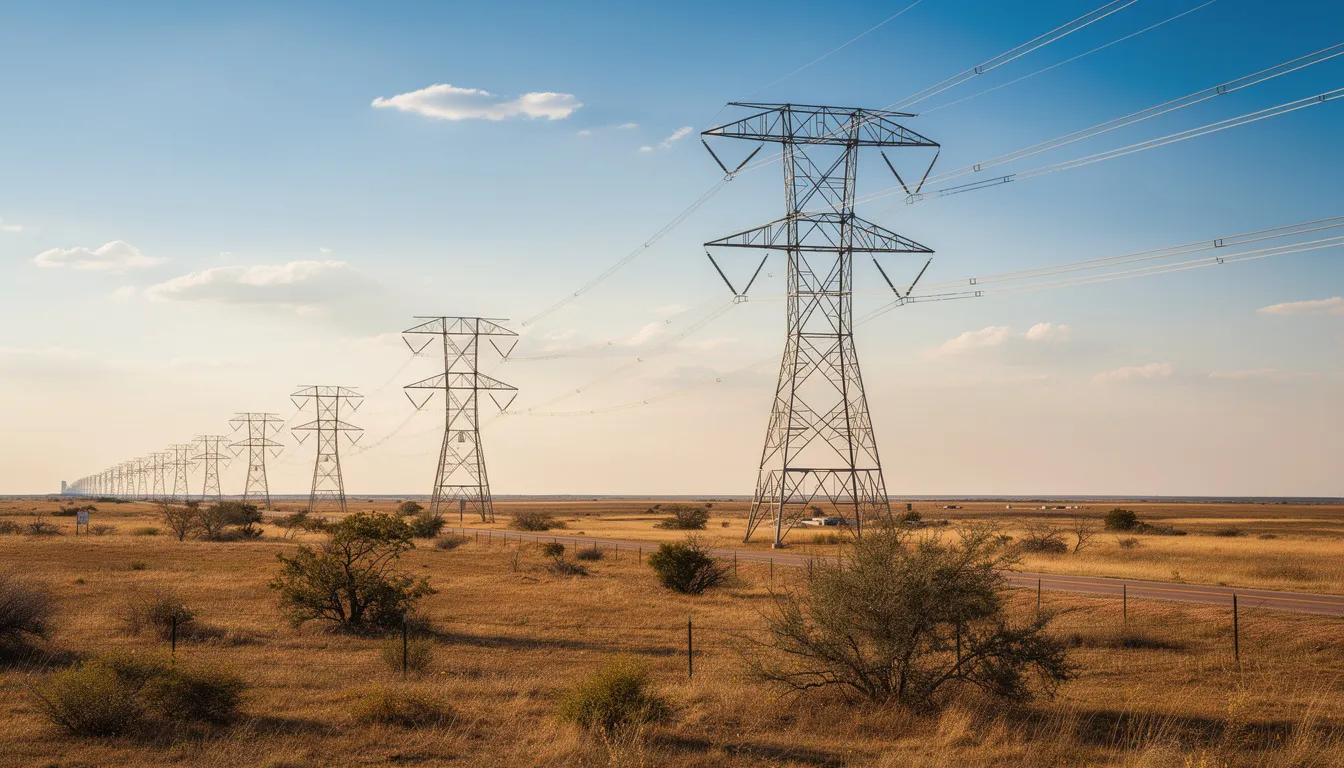
ERCOT Grid Expansion and Transmission Buildout
Rapid load growth in Texas is not theoretical. ERCOT publishes yearly peak demand records, including the 85,508 MW record on August 10, 2023. The grid is being asked to serve population growth, industrial electrification, and a surge of large-load requests tied to data centers and manufacturing.
What the data says about demand growth
ERCOT’s public monthly reporting has referenced updated forecasting discussions projecting peak load could reach 150 GW by 2030. That single number changes how owners should think about 2026 sequencing. When interconnection and transmission work becomes the constraint, the “fastest schedule” is the one that can actually get power.
ERCOT board materials also show how fast the large-load queue has grown. For example, a December 2025 system planning update notes ERCOT received 225 new large-load interconnection requests in 2025. Separately, ERCOT’s constraints and needs report describes tracking nearly ~239 GW of large-load interconnection requests (not all of which will materialize). This is the scale of what the market is trying to build toward.
Transmission work is a construction market in its own right
ERCOT’s operational overview reporting shows transmission project dollars moving through engineering, routing, licensing, and construction, with totals in the tens of billions across the pipeline.
In 2026, the construction implications are straightforward:
- More substation builds and expansions near growth metros
- More line routing, civil packages, foundations, and access road work
- More schedule coupling between private megaprojects and utility delivery
This creates sustained demand for electrical contractors, civil crews, and EPC teams that can execute power delivery work on tight constraints. It also changes hiring pressure. High-performing PMs and superintendents get pulled into whichever project can offer stability plus a clear sequence.
Gulf Coast Industrial and LNG Expansion
The Texas Gulf Coast remains one of the world’s most active industrial construction regions. LNG terminals, petrochemical facilities, and supporting logistics packages keep generating large scopes that pull the same leadership pool that heavy civil work needs.
LNG export terminal activity
Texas continues to sit at the center of LNG growth. One current example: Reuters reported the U.S. Department of Energy approved a 12% increase in authorized LNG export capacity tied to Cheniere’s Corpus Christi terminal (referencing trains 8 and 9 of the Stage 3 project). That is not “future talk.” That is capacity planning landing inside the 2026 window.
From a construction execution lens, LNG work drives:
- Large civil and marine scopes (berths, dredging support, heavy-haul access)
- MEP and specialty packages competing with other industrial sites
- Commissioning and turnover schedules that demand experienced leadership
Petrochemical and refinery work
Petrochemical work in Texas includes a constant blend of retrofits, debottlenecking, emissions controls, and brownfield additions. The key 2026 reality is not one headline project. It is the overlapping volume of work orders plus the labor competition created when multiple sectors peak at once.
For contractors trying to balance field leadership across sectors, this is where the market splits into two groups:
- Firms that staff early and can hold a bench
- Firms that wait and pay for it in turnover, premium labor, and schedule drift
Semiconductor and Advanced Manufacturing Growth in Texas
Texas has become a major U.S. semiconductor manufacturing market, and several projects are explicitly tied to a 2026 operating window.
Major semiconductor projects (verified)
Samsung Taylor: Samsung states it plans a minimum $17B investment for the Taylor, Texas fab build-out. Manufacturing industry coverage continues to reference the same $17B figure and a 2026 operational timeline. What is not safe to print as fact without tighter sourcing is node size, wafer output, or yield claims, so those have been removed here.
Texas Instruments Sherman: TI describes its Sherman mega-site as a potential $40B investment with plans for up to four connected fabs. TI has also publicly discussed broader U.S. manufacturing investment, with Sherman positioned as the center of gravity for analog capacity expansion.
Why semiconductors change the construction market
These sites pull a specific labor profile: cleanroom-capable superintendents, MEP coordinators, QA/QC leadership, and project controls talent that can manage phased turnover. When these builds stack on top of transportation and industrial work in the same corridor, staffing becomes a constraint, not a “later” problem.
Data Center Development: Texas as an AI and Cloud Hub
Data centers are not the largest share of Texas capital work, but they are one of the fastest-moving drivers of large-load growth, which loops back into ERCOT scheduling and transmission work.
2026 development expectations (verified where possible)
Hyperscale investment: Google announced a $40B investment in Texas through 2027 tied to cloud and AI infrastructure, including new data center campuses.
Power density reality check: It is not accurate to claim “1–2 MW per rack” as a normal planning baseline. Uptime Institute reporting indicates average rack densities are rising but still mostly below 8 kW, with most facilities reporting few racks above 30 kW today. Extreme AI densities may emerge, but they should be framed as “edge cases and coming shifts,” not standard practice.
Interaction with energy and transmission
Data centers matter to 2026 construction for one main reason: they accelerate the power constraint. ERCOT has publicly discussed peak demand potentially reaching 150 GW by 2030, and its planning updates show a surge in large-load interconnection requests. Source
For construction firms, this creates repeatable but demanding work:
- Fast-track schedules that punish weak precon planning
- Mission-critical MEP scopes that compete with semiconductors and industrial work
- Commissioning and turnover leadership demand that does not slow down
If you are hiring into this cycle, it is worth aligning data center staffing with the broader market reality using current salary data, not 2022 assumptions.

How the $142B Buildout Reshapes Texas Construction Demand by 2026
By 2026, Texas construction activity is defined less by isolated projects and more by stacked programs that share the same labor shed. That convergence creates opportunity, and it creates failure modes for teams that do not staff early.
Regional impact concentrations
Central Texas (Austin–San Antonio–Taylor): Corridor mobility work plus semiconductor construction creates sustained demand for leadership that can run complex civil and high-spec building scopes in the same market window.
Gulf Coast (Houston–Beaumont–Corpus Christi): LNG and industrial work stacks with port access, freight connectors, and long-duration urban freeway reconstruction.
North Texas (Dallas–Fort Worth–Sherman): Transportation packages plus electronics manufacturing growth and hyperscale activity keep pressure on both commercial and industrial leadership pools.
Market dynamics through 2026 (surgically corrected)
Leadership competition: This is the core story. When heavy civil, industrial, and high-tech building peaks overlap, experienced superintendents and senior PMs become the constraint.
Interconnection pressure: Power delivery and transmission scheduling can become the gating item for private megaproject turnover. ERCOT’s public reporting about demand growth and large-load queues is a strong indicator of this constraint.
Hiring signal: In this cycle, job-seeker demand follows project certainty. That is why Texas postings cluster around stable pipelines. You can see it clearly across commercial jobs and sector-specific demand such as data center roles.
Workforce and Leadership Implications for Contractors and Developers
The Birmingham Group sees Texas as one of the most talent-competitive construction markets heading into 2026. The volume of stacked programs means the “late hiring” penalty is real, and it shows up in offer acceptance, schedule drift, and leadership churn.
Affected leadership and field roles
- Senior heavy civil leadership with TxDOT program execution experience
- Industrial and LNG project leaders with Gulf Coast brownfield and greenfield backgrounds
- High-tech building leaders who understand clean construction controls and turnover sequencing
- MEP coordinators, commissioning leadership, and QA/QC managers (mission-critical and high-tech)
- Estimators and project controls leaders who can model risk and escalation in active markets
How organizations are responding
National recruiting: Firms continue pulling leadership into Texas from other regions, then supporting travel and rotation structures to keep people longer.
Earlier pipeline building: This is the cleanest competitive advantage. Owners and contractors that build a bench before award windows hit can staff without panic.
Comp alignment: Firms that rely on stale pay bands lose. If you need a baseline tied to current market conditions, the fastest reference point is the salary survey.
If your 2026 plan includes heavy civil staffing pressure, this Texas-specific breakdown also aligns with what we are seeing in contractor priorities: heavy civil roles.
Conclusion: Navigating Texas Mega Projects Through and Beyond 2026
Texas is not facing a single “mega project year.” It is facing stacked programs. The record $142B UTP, ERCOT load growth signals, Gulf Coast LNG and industrial work, semiconductor expansion (Samsung and TI), and hyperscale investment (Google) combine into one reality: 2026 is a staffing and sequencing problem as much as it is a construction opportunity.
Owners and contractors that win this cycle do three things earlier than competitors:
- They monitor letting and program movement through primary sources
- They lock leadership benches before urgency hits
- They benchmark comp to current market data, not prior cycles
Texas is not entering a normal growth cycle. It is entering a convergence cycle. Transportation, grid expansion, LNG, semiconductors, and hyperscale infrastructure are all peaking within overlapping windows. That reality will reward contractors who secure leadership early and penalize those who wait.
If you are staffing against 2026 workloads, align your compensation and hiring strategy with current Texas market conditions using verified construction salary data. The margin between staffed and short-handed in this cycle will be measurable in schedule performance.
Hiring managers planning ahead can begin building leadership pipelines through our construction search team. Candidates evaluating Texas opportunities can review active demand across major programs inside our construction job listings.
FAQs
What kind of transportation projects are being implemented by TxDOT in Texas?
TxDOT’s Unified Transportation Program funds a wide range of projects statewide, including highway expansion, interchange reconstruction, freight corridor improvements, and multimodal enhancements. Permitting and coordination phases — like utility permits — can take extended time (e.g., 90+ days for a utility permit) as part of typical project delivery processes.
Why are data centers considered a challenge for the Texas electric grid?
Texas is seeing significant data center growth, but not all planned capacity will necessarily be built exactly as proposed. Experts note that just because a load enters ERCOT’s queue doesn’t guarantee construction — making actual demand harder to predict and complicating grid planning.
How early can contractors identify upcoming private construction projects?
Before private work is publicly posted for bid, early indicators like land sales, zoning requests, and permit filings can signal upcoming projects months in advance. Tracking these signals gives contractors a competitive edge in planning and resourcing.
How long does it typically take to get a utility permit from TxDOT?
When construction involves utility work in a TxDOT right-of-way, contractors should generally allow at least 90 days to secure utility permits, according to TxDOT’s own FAQ guidance.