
Data Center Mega Projects: Distinguishing Real Backlog From PR Noise
If you work in commercial construction today, you already see where capital is flowing.
Data center projects are showing up across more markets, at larger scales, and with longer planning horizons.
This is not speculation. Demand for computing capacity continues to expand as artificial intelligence, cloud platforms, and enterprise systems scale.
For general contractors, specialty firms, and design-build organizations, this creates a large and durable field of opportunity.
The practical question is not whether the work exists.
The question is how to separate projects that are moving toward execution from those still progressing through early development stages.
That distinction drives staffing plans, preconstruction investment, and leadership deployment for hiring managers planning multi-year growth.
The Issue Is Not Volume. It Is Classification.
Data center development is attracting capital at a scale rarely seen in nonresidential construction.
Large campuses are being announced with budgets comparable to major infrastructure programs.
That capital is real.
What varies is sequencing.
Some projects progress steadily through power, permitting, and procurement. Others remain in extended planning while those pieces are aligned.
From the outside, both appear identical.
From an execution standpoint, they are not.
Firms that classify backlog accurately allocate resources earlier and more deliberately. That consistency supports utilization, margin stability, and predictable growth.
Why Announcement Activity Continues to Increase
Most data center announcements are tied to long-term infrastructure demand.
AI workloads require higher compute density. That increases power demand, cooling requirements, and site coordination.
Developers respond by securing land and utility positioning early, often across multiple regions.
This behavior reflects optionality and planning, not uncertainty.
Industry reporting continues to show data centers among the strongest drivers of nonresidential construction planning, according to Engineering News-Record.
That level of activity supports a sustained construction cycle rather than a short-term spike.
For firms tracking active construction jobs, the volume of leadership hiring reflects that steady progression.
Power Availability Defines Execution Timing
In data center development, power coordination sets the construction timeline.
Projects with defined utility paths, approved interconnects, and planned substation work tend to move forward in measured phases.
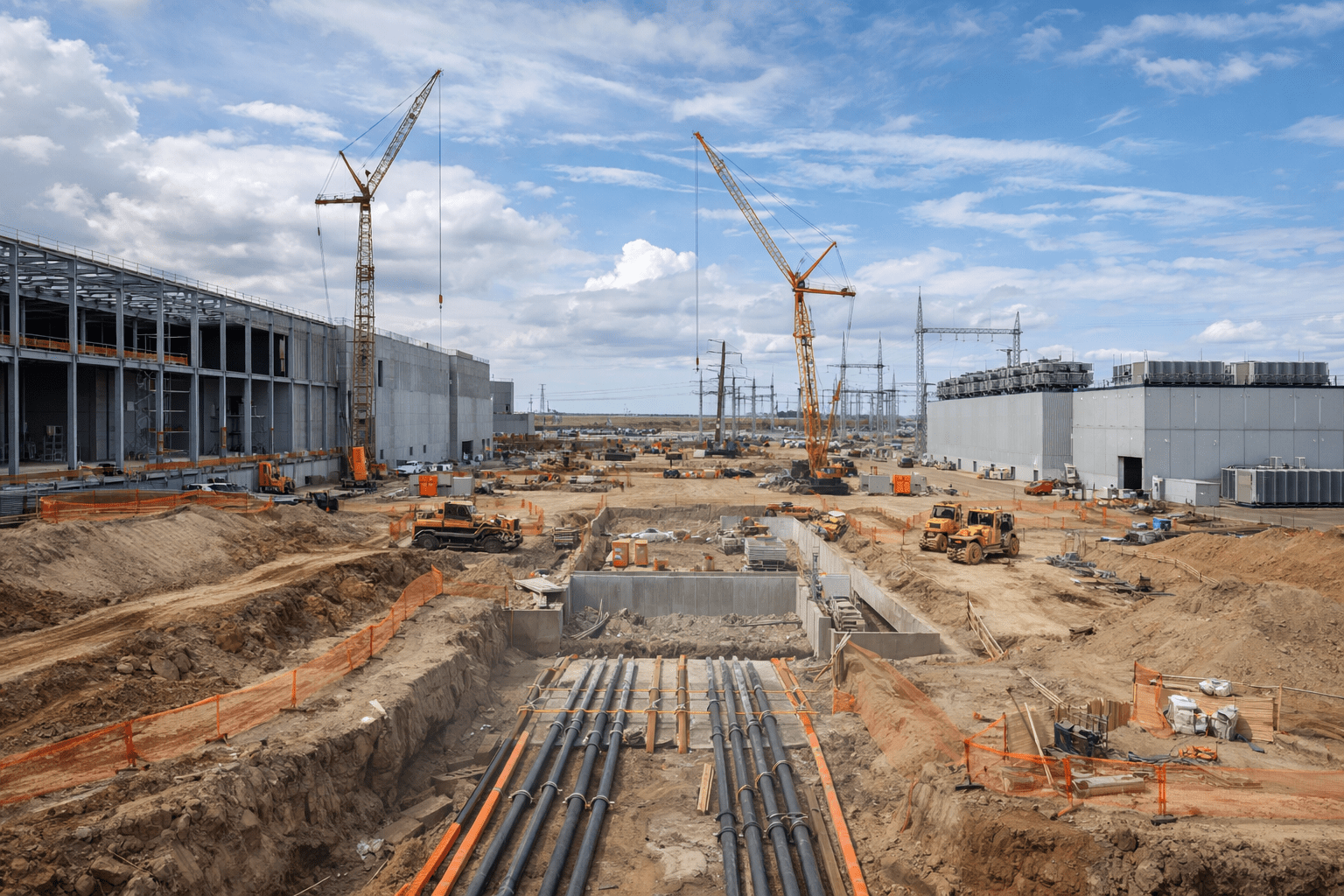
Those phases often include substantial off-site infrastructure work before vertical construction begins.
This sequencing benefits experienced contractors who understand utility coordination and phased delivery.
Federal energy data continues to show sustained growth in electricity demand driven by large computing facilities, reinforcing long-term infrastructure investment, as outlined by the U.S. Department of Energy.
For staffing purposes, projects with approved power scopes provide the clearest signals for leadership planning and recruiter engagement.
Permitting Progress Adds Predictability
Permitting remains an important sequencing step, not a barrier.
Municipalities continue to support data center development for its tax base and long-term economic contribution.
As campuses scale, permitting processes have become more structured and transparent.
Projects that reach formal site plan approval typically move forward on defined schedules.
This predictability supports workforce planning and allows firms to deploy teams with confidence.
Procurement Activity Confirms Momentum
Mission-critical equipment procurement is another reliable execution signal.
Generators, transformers, switchgear, and cooling systems require long manufacturing lead times.
Developers committing capital to OFCI packages are aligning procurement with construction schedules.
This level of commitment reinforces steady progress rather than speculative intent.
Contractors involved early in preconstruction and procurement coordination often become long-term delivery partners.
Client Type Shapes Delivery Profiles
Hyperscalers and established colocation developers continue to anchor much of the market.
These groups tend to operate with defined capacity needs and structured rollout plans.
New entrants also appear as the sector expands, adding breadth to the market.
Firms that prioritize relationships with repeat developers benefit from continuity and consistent execution flow.
Staffing to Sequencing, Not Headlines
Accurate backlog classification supports balanced staffing.
Leadership teams that align hiring with project sequencing avoid utilization swings.
This approach supports retention, internal development, and long-term team stability.
For professionals evaluating opportunities, visibility into active pipelines through candidate discussions helps align career moves with execution-ready work.
Compensation Benchmarks Support Confident Hiring
As mission-critical work expands, compensation for experienced leaders continues to adjust.
Reliable data matters more than assumptions.
Resources like the construction salary survey help firms align offers with current market behavior.
Clear pipelines, defined sequencing, and competitive compensation reinforce confidence for both employers and candidates.
The View From the Market
Understanding this market requires more than reading announcements.
It requires seeing which projects are staffing, which teams are expanding, and which developers are moving from planning into execution.
This is where real market visibility matters.
Firms operating in mission-critical construction benefit from intelligence that reflects what is actually happening on the ground. Who is hiring. What roles are opening. How compensation is moving.
This visibility allows leadership teams to plan with confidence rather than react to headlines.
At The Birmingham Group, this perspective comes from constant interaction with general contractors, specialty firms, developers, and construction leaders across active data center markets.
Patterns emerge quickly.
Some projects begin staffing months ahead of vertical construction. Others sequence leadership later, after power and procurement are fully aligned.
Recognizing those patterns helps firms align hiring decisions with execution timing.
Why Specialized Market Insight Matters
In a growing sector, general information is rarely sufficient.
Compensation benchmarks change quickly. Hiring velocity shifts by market. Certain roles tighten faster than others.
Data that is even a few months old can lag reality.
This is why firms increasingly rely on niche market insight rather than broad industry surveys.
Specialized recruiters see compensation offers, counteroffers, and acceptance trends in real time.
That insight helps firms calibrate pay, structure roles, and move decisively when leadership needs arise.
It also supports candidates evaluating opportunities across multiple projects and markets.
Benchmarking Compensation With Confidence
As data center work continues to expand, compensation for experienced mission-critical leaders continues to adjust.
This is not driven by hype. It is driven by demand for specific experience.
Superintendents, Project Managers, Estimators, and Project Executives with data center delivery experience remain in strong demand.
To hire confidently, firms need accurate benchmarks.
Resources like the construction salary guide help ground compensation decisions in current market data.
This allows firms to structure offers that attract talent while supporting long-term profitability.
For candidates, it provides clarity around role value and career progression.
What Candidates Should Look For
For construction professionals considering mission-critical roles, project sequencing matters.
Strong opportunities are tied to projects with clear power paths, defined procurement schedules, and visible staffing plans.
These projects provide continuity, technical exposure, and leadership growth.
Firms that can explain their pipeline clearly tend to attract and retain top performers.
Confidential conversations through candidate outreach often help professionals assess fit before making a move.
What Hiring Managers Should Focus On
For hiring managers, clarity is the advantage.
Projects that are sequenced deliberately support better staffing decisions.
When leadership hiring aligns with execution timing, teams remain balanced and utilization stays healthy.
This approach supports retention, internal development, and consistent delivery.
Early engagement through hiring manager intake allows firms to plan rather than react.
Looking Ahead
Data center construction continues to be driven by structural demand.
Artificial intelligence, cloud adoption, and digital infrastructure expansion are long-term forces.
The market rewards firms that classify backlog accurately and staff with discipline.
The opportunity is substantial.
The firms that perform best will be those that align people, projects, and timing.
Execution remains the differentiator.
Building the Right Team
If you are planning leadership hires tied to mission-critical work, the starting point is clarity.
Clear sequencing. Clear staffing plans. Clear compensation benchmarks.
The Birmingham Group has been supporting construction leadership teams since 1967.
We understand how data center projects move from planning into execution.
Whether you are building a team or evaluating your next move, informed decisions create durable outcomes.
Book a time to discuss hiring strategy or career alignment with Brian!
Frequently Asked Questions
How can construction leaders tell if a data center project is real work or just an announcement?
Executable data center projects typically show clear progress in power coordination, permitting status, procurement activity, and staffing plans. Projects moving toward construction often have approved utility paths, active site approvals, and defined timelines for leadership hiring.
Why are so many data center projects announced before construction begins?
Many data center announcements reflect long-term planning, land positioning, and utility coordination rather than immediate construction. Developers often announce projects early to secure power access, zoning alignment, and regional optionality while sequencing execution over time.
What signals indicate a data center project is moving toward execution?
Projects moving toward execution usually show activity in power infrastructure planning, site plan approvals, long-lead equipment procurement, and early leadership staffing. These indicators suggest alignment between development planning and construction sequencing.
How should hiring managers plan staffing for large data center projects?
Hiring managers benefit from aligning leadership hiring with project sequencing rather than announcements. Staffing plans tied to power availability, permitting progress, and procurement schedules support balanced teams, steady utilization, and predictable execution.