A construction safety manager is no longer just the person who knows the rules.
That combination is not easy to find.
For hiring managers, the question is not only where to find a construction safety manager. The better question is whether the person can actually influence the field when the schedule is tight, the crew is moving fast, and the easy answer is to look away.
Why Construction Safety Manager Hiring Has Changed
Construction has always carried risk. OSHA notes that construction workers can be exposed to serious hazards, including falls, unguarded machinery, struck-by hazards, electrocutions, and silica dust.
That reality makes construction safety management different from safety work in a controlled facility. The jobsite changes every day. Access changes. Weather changes. Crews change. Deliveries change. One trade’s shortcut can create exposure for another trade an hour later.
That is why safety cannot sit outside operations.
A strong construction safety manager is involved before the problem shows up. They look at sequencing, site logistics, manpower, lift plans, pre-task planning, subcontractor readiness, and superintendent pressure. They understand when the plan on paper does not match what is happening in the field.
OSHA’s safety management guidance points to management leadership, worker participation, hazard identification, prevention, training, and program improvement. On a construction project, those ideas only work when someone can turn them into daily field behavior.
That is the shift.
The role is not just compliance. It is execution.
The Talent Pool Is Smaller Than the Resume Search Suggests
At first glance, safety looks like a clear hiring category. Search for safety resumes, filter by construction, check for certifications, and start calling.
That approach misses the real problem.
The title does not tell you whether someone can lead. A candidate may have the right credential and still struggle with superintendents. Another may have strong field instincts but weak documentation discipline. Another may know the rules but avoid hard conversations when production pressure rises.
That is why construction safety manager jobs can stay open even when the market appears full of safety candidates.
The broader labor picture adds pressure. The Bureau of Labor Statistics projects 12 percent employment growth for occupational health and safety specialists and technicians from 2024 to 2034, with about 18,300 openings each year on average. That demand is not limited to construction.
At the same time, Associated Builders and Contractors estimated that construction must attract 349,000 net new workers in 2026 to meet demand.
Good safety leaders know they have options.
They may be choosing between general building, civil, industrial, healthcare, data center, infrastructure, and owner-side roles. The best ones are usually not unemployed. They are already working for contractors that understand what strong safety leadership is worth.
Compliance Knowledge Is Not Enough Anymore
Compliance still matters. No serious contractor can treat it as optional.
OSHA’s most frequently cited standards continue to show the same kinds of risks contractors deal with every day, including fall protection, hazard communication, ladders, respiratory protection, scaffolding, and powered industrial trucks.
Those are not abstract issues. They show up in real jobsite decisions every day.
Should that crew be working at elevation before the fall protection issue is fixed? Is the access route safe, or has it slowly become a hazard because materials were staged in the wrong place? Does the pre-task plan reflect today’s work, or is it just a copied form from yesterday?
The safety construction manager who adds value can answer those questions without turning every issue into a shutdown or a shouting match.
That balance is hard.
In 2024, BLS reported 1,032 fatalities among construction and extraction workers. OSHA also reports that falls remain the leading cause of death in construction.
Those numbers are the reason the role cannot be treated as paperwork support.
Construction site safety management has to prevent exposure before someone gets hurt. That requires judgment, urgency, communication, and the backbone to challenge unsafe behavior even when the project is under pressure.
Field Credibility Is the Requirement You Cannot Fake
The hardest part of hiring a construction safety manager is measuring field credibility before the person is on the job.
Credentials matter, but crews do not follow a credential. Superintendents do not respect a title by itself. Trade partners do not change behavior because someone read from a manual.
They respond to someone who understands the work.
Picture a live commercial project. A concrete crew is pushing to finish. Steel is being delivered. Interior trades are asking for access. The superintendent is protecting the schedule. The owner is walking the site later that day.
A safety issue appears.
A weak safety manager reacts in one of two ways. They either overcorrect without understanding the sequence, or they stay quiet because they do not want to create conflict.
A strong safety manager does something different.
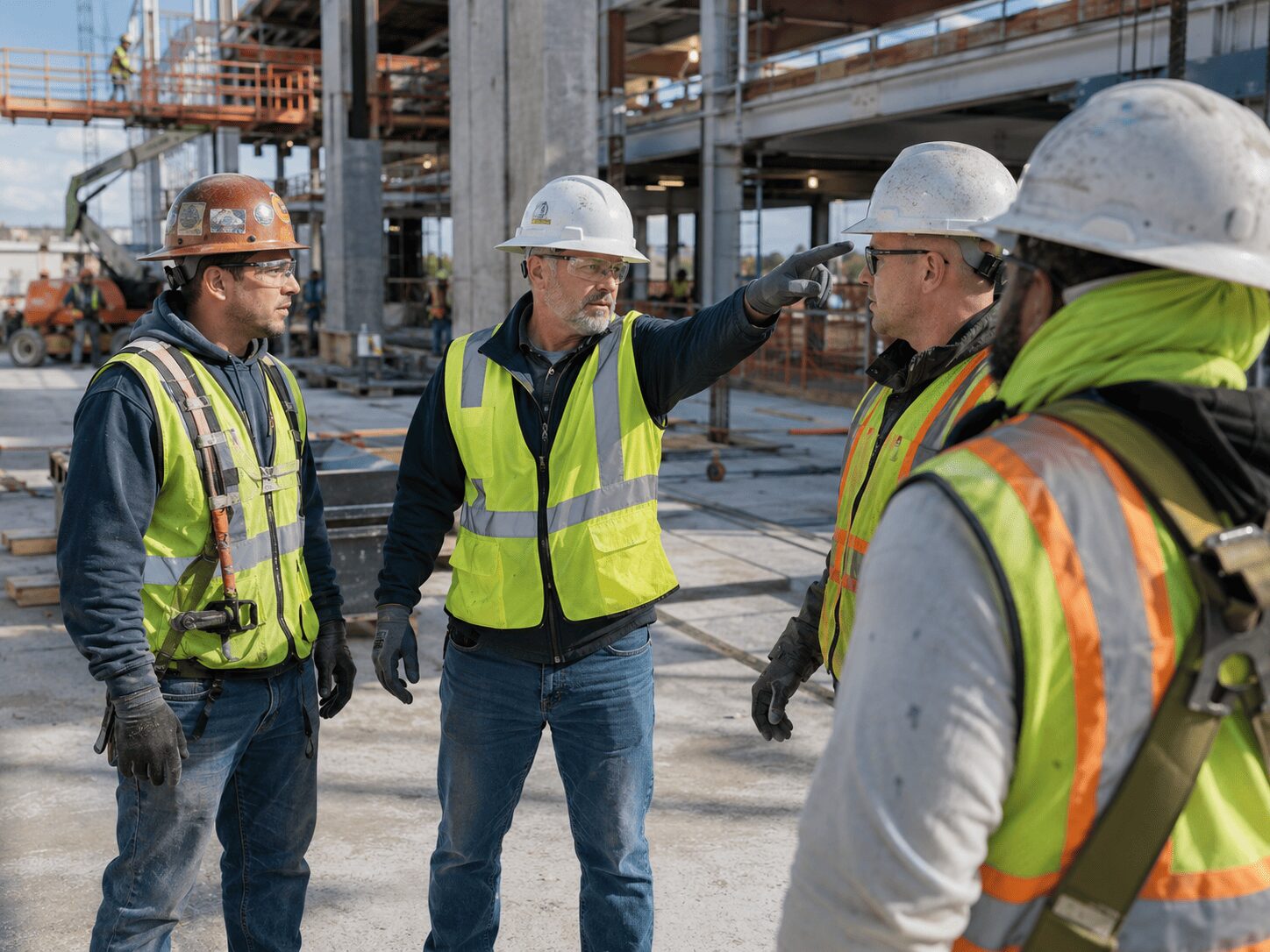
They identify the real exposure. They talk to the superintendent directly. They explain the risk to the foreman in plain language. They help find a safe path forward. They document what needs to be documented. They do not make the issue personal, but they do not let it slide.
That is leadership.
It is also why hiring for this role cannot be handled like a generic checklist search. The best candidates combine field awareness, communication, follow-through, and authority. They know when to teach, when to push, and when to stop the work.
How Hiring Managers Should Structure the Search
The search should start with the jobsite reality, not the job title.
Before opening the role, hiring managers should be clear on the project types, risk profile, travel expectations, reporting structure, subcontractor environment, and level of authority the person will actually have.
A site-level safety manager on one healthcare project is not the same as a regional safety leader covering multiple active jobs. A safety manager supporting interiors work is not the same as one supporting heavy civil, industrial, or data center construction. A company trying to improve documentation needs a different profile than a company trying to change field culture.
The compensation band also has to match the responsibility. If the role carries high accountability but the salary does not match the market, the search will drag. Before posting the role, compare the compensation plan against current construction salary data so the search does not start behind.
From there, the interview should test judgment.
Ask candidates how they handle a superintendent who wants to keep moving before a hazard is corrected. Ask how they deal with a repeat subcontractor issue. Ask what they document immediately and what they coach in the field. Ask how they earn trust without becoming soft on standards.
The answers will tell you far more than a list of certifications.
Construction Safety Manager Salary Ranges in 2026
Salary is not the only reason construction safety manager roles are hard to fill, but it affects how fast the search moves. If the role requires real field authority, multi-site responsibility, high-risk work, or travel, the compensation has to match the level of responsibility.
National salary data gives hiring managers a useful starting point, but the final range should still reflect project type, geography, travel, risk level, and how much authority the safety leader will actually carry.
| Role Scope | Typical Salary Range | Hiring Takeaway |
|---|---|---|
| Safety coordinator or early-career site safety role | $50,610 to $74,500 | This range may fit support-level safety roles, but it is usually light for a true construction safety manager with field authority. |
| Site-level construction safety manager | $74,500 to $100,000 | This is a common national range for many construction safety manager jobs, especially single-site roles with clear project support duties. |
| Experienced construction safety manager | $100,000 to $130,460 | This range is more realistic when the role requires strong field leadership, subcontractor influence, documentation control, and direct support to project leadership. |
| Senior, regional, high-risk, or multi-site safety leader | $130,460 to $146,522+ | This range becomes more relevant when the person is expected to lead safety across multiple projects, high-risk scopes, major commercial work, or travel-heavy assignments. |
The main point is simple. If a company wants a safety leader who can influence the field, challenge unsafe behavior, support superintendents, and protect the project under pressure, the offer cannot be built like a basic compliance role.
The Takeaway
Construction safety manager hiring is getting harder because the job now demands a rare combination.
The person has to understand compliance, but not hide behind it. They need field credibility, but also documentation discipline. They need communication skills, but also backbone. They need to support production, but never let production erase responsibility.
That is a leadership profile, not a generic safety opening.
If your team is trying to hire a safety leader who can earn trust in the field and hold standards under pressure, construction recruiting support can help sharpen the search before the wrong candidates waste time.
For compensation benchmarks, see our dedicated guide to construction safety manager salary in 2026, including SSHO pay and sector-by-sector ranges.
nn